Friday, May 24, 2013

Cusco, Peru

We arrived in the city of Cusco on the evening of May 20th. Cusco was the capital of the Inca Empire, and it has an altitude of 3,400 metres. It is also a major tourist destination, as many people start in Cusco before heading over to Machu Picchu. I liked the city, it has old cobble stone streets and cute historical buildings. After the Spanish invaded the city in 1533 they brought their Spanish influence, and so the buildings have a mixture of Spanish and Inca architecture. Many of the Inca buildings were destroyed by the Spanish, but the Spanish used the walls and bases of the Inca buildings to construct other buildings. The Spanish also constructed many churches in their quest to spread Christianity through the region.

I visited a few sights in Cusco, but mainly it was also a city in which I was able to relax a bit after non-stop traveling! I was finally able to get some laundry done, and I also took one afternoon to pamper myself with a 1-hour massage.

We visited the Convent of Santo Domingo, which was built by the Spanish by using the structure of the Qurikancha temple, which was an important Incan sanctuary dedicated to the Sun God. I only have limited amount of photos from inside as most areas of the convent did not allow photography.

IMG_2831

IMG_2819

We also had the chance to visit a local market, which sold meats, fruits, clothing, and had stations where you could order food and benches to eat at.

IMG_2863IMG_2853IMG_2867IMG_2841 IMG_2876IMG_2847

The main square of Cusco is very pretty, with a fountain in the middle, and is surrounded by the Cathedral, and lots of touristy shops and restaurants.

IMG_2879

The main square is also very alive at night, and you can see a great view of the cathedral.

IMG_2883

IMG_2882

Earlier in the day when I had been exploring the Convent of Santo Domingo I ran into my friend Mohit from Rotman (University of Toronto)! He was traveling through Peru, and I had no idea he was in Cusco! It was such a surprise! We agreed to meet up later to catch up. This was the second time I had run into someone while in Peru! First I ran into my cousin in Lima last week, and now Mohit! What a small world!

2013-05-21 18.40.13

That evening we took a bartending lesson, and learned to make a delicious Peruvian drink with passion fruit.

IMG_2886 

IMG_2898

Us with our drinks and our teachers:

IMG_2908

The visit to Cusco was short, but I will be back in a few days and I’ll be able to see more once I return.

Thursday, May 23, 2013

Puno to Cusco, Peru

We left Puno on May 20th and drove to Cusco. As we were leaving Puno we had a great view of the city with the mountains and Lake Titikaka in the background:

IMG_2674

We learned something very interesting about the houses in the area around Puno. Many houses are unfinished, where there is a completed main level with a ceiling, but the second level is incomplete, with metal bars and only the beginnings of the wall structure. We learned that many families purposely do not complete their houses because while a house is still being built the family who owns it does not have to pay taxes. So many houses will forever remain incomplete so that families can avoid paying taxes.

Another thing I learned was how prevalent tuk-tuks are in this area. We had taken a couple tuk-tuks (3-wheeled taxis, very similar to the ones in Thailand and in other parts of Southeast Asia) during this trip, but in area around Puno I noticed them everywhere!

IMG_2688

We stopped in the small town of Pucara to explore it and to see the church and houses. The town is beautifully set just beside the mountains.

IMG_2691

IMG_2698

Walking down the little streets you can see that many of the houses were built by hand:

IMG_2700

The drive was through the mountains and it was just beautiful. I spent the majority of the time on the bus staring out the window admiring the beauty of the area. We made a couple of stops along the way to admire the scenery:

IMG_2711

And at almost every stop there were lots of vendors selling Peruvian souvenirs like scarves, sweaters, hats, etc.

IMG_2712

I also got a chance to meet a local Peruvian woman and her pets:

IMG_2714

Driving along the highway we could see a number of local houses, and could see that they were almost all made by laying bricks by hand, and with different types of roofs.

IMG_2723

IMG_2755

We visited Raqchi, which is an Inca archaeological site, and the home of the Temple of Wiraqocha, which was a very large two-storey rectangular structure, and is believed to be the largest single roof in the Incan Empire. It is also the only remaining two-storey Inca wall. Unfortunately the temple was destroyed by the Spanish, and only the central wall remains:

IMG_2766

We also explored the areas surrounding the temple which included living areas and storage areas. We saw a lot of locals walking around the area of the ruins.

IMG_2772

IMG_2789

After a long day of driving and sight-seeing we finally arrived in the city of Cusco late that afternoon. Unfortunately that evening was the first time I had started to feel the effects of the high altitude! Cusco is at an altitude of 3,400 metres, which is lower than our previous days in Puno, but still pretty high. The altitude caused my head to start hurting really badly, and my nose started bleeding. I couldn’t get my nose to stop bleeding, so I imposed a no-photo policy in my hotel room and walked around with Kleenex shoved up my nostrils until the bleeding subsided. Luckily those were the only effect of altitude I experienced, and I was feeling fine by morning.  

Wednesday, May 22, 2013

Puno and Lake Titikaka, Peru

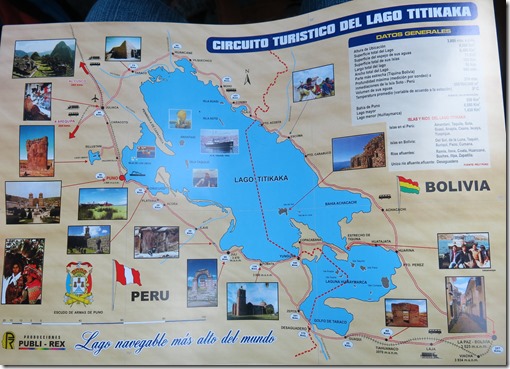
We spent May 19th in Puno, mainly exploring the famous Lake Titikaka, which is on the border between Peru and Bolivia. Lake Titikaka is the highest navigable lake in the world, and it is at an altitude of 3810 metres. It is a very large lake, and at it’s widest length it is 190 km. We visited two areas on this lake: Uros Islands and Taquile Island.
IMG_2423

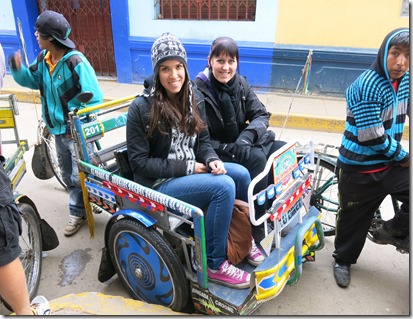
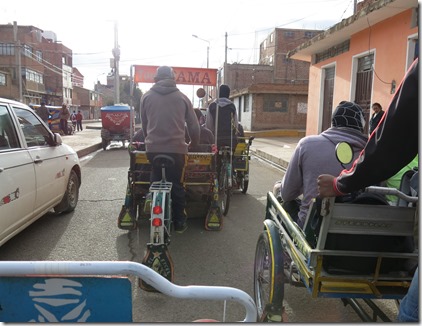
To get to the boat which would take us to the islands we took a form of tuk-tuk, where we were the front carriage of a bicycle and rode on the street through traffic:
IMG_2403

IMG_2416

We first went to the Uros Islands, which are a group of about 44 artificial islands made of floating reeds. It was so interesting visiting these islands and learning about the people who live on them. Each island is inhabited by a number of families, all related to one another. The reeds that they use to make their islands grow naturally in the area, and are used for almost everything including making their houses, boats, chairs, and they even eat them!

IMG_2435

IMG_2445

IMG_2505

We had the chance to actually visit one of the islands, meet the families on the island and see their homes. As our boat approached the island the family members were waiting for us.

IMG_2441

It was so strange walking on reeds! There was a lot of spring in the ground, it almost felt like we were walking on a trampoline!

IMG_2450

They gave us a demonstration on how the islands were made. Each island was made by hand by using reed roots which were dug up from other areas in the lake. These reed roots were used as the base of the island, and then reeds were piled in layers on top, and then finally the reed houses were built the very top. In order to make their fireplaces they needed to go to the mainland and get large stones for underneath the fire, because one flame could set the whole island on fire!

IMG_2461

IMG_2509

I was so amazed at how these families could live on these islands. First of all it was freezing (it was under 10 degrees Celsius), and there is no insolation in the reed houses. Secondly, the women wear authentic Peruvian clothing, which consists of many layers of skirts, and none of them wear shoes!

IMG_2478

One of the ladies on the island invited me and my roommate into her home, and dressed us up in authentic clothing:

IMG_2486

DSC08383

In order to make money, the women on the island make handicrafts like beautifully embroidered pillow cases and table cloths (which can be seen in the photo above).

I really enjoyed my visit to these islands, but I also found it a bit eye opening. I couldn’t imagine living on these islands, isolated from the city and without insolation from the cold!

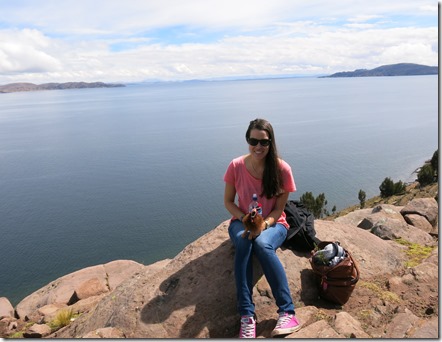
We also visited Taquile island, which was just beautiful! The population of the island is about 2,200 people, and it’s a 2 hour boat ride from Puno. Our first challenge was to climb a very high hill, which was at an altitude of almost 4000 metres. This climb was actually pretty challenging! You don’t realize how much an effect the altitude has on you until you try to do some physical activity! It was well worth it because the view from the top was amazing.
IMG_2522

IMG_2523

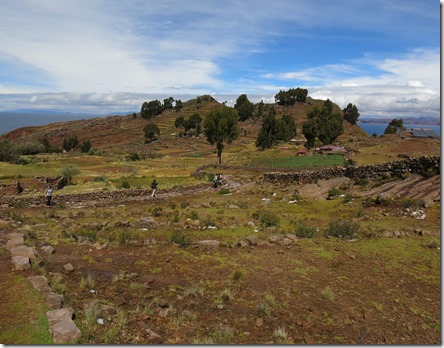
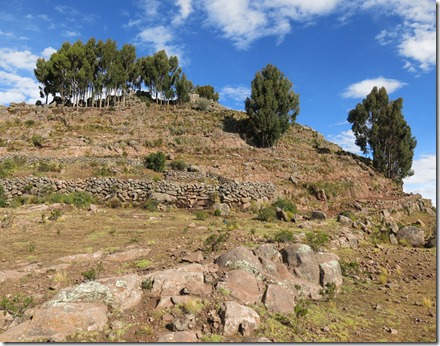
The island had beautiful scenery as it was covered in hills and terraces and ruins.
IMG_2535

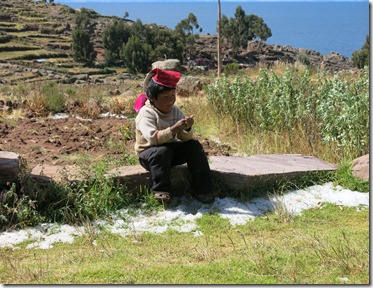
We had the chance to meet a local family, and they taught us some interesting things about their culture. First off, all Taquile men wear hats, and the style of the hat is different depending on if they are married or not. If they are unmarried they wear a white hat, with a bright bottom and a bright pom-pom at the end, but if they are married they wear a colourful hat with a bright pom-pom at the end. For unmarried men, depending on the side the pom-pom falls it indicates whether or not they are in a relationship (but not yet married).  In the photo below, two guys from my tour are demonstrating the hats.

IMG_2543

Male children also wear these hats, but they will let the pom-pom fall in the back of their head, indicating that they are not looking for a relationship.
IMG_2546

We also learned about how the Taquil people find their partners. If a boy likes a girl, it is customary for them to throw a small stone at the girl. If the girl then throws a stone back at him then the connection is made, but if the girl does not then it indicates that she is not interested. Another way to get a girl’s attention is to shine a mirror towards her house so the light is reflected into the house. If she shines a mirror back then she is interested. Hearing these rituals makes me realize how complicated we make the dating ritual in our culture!

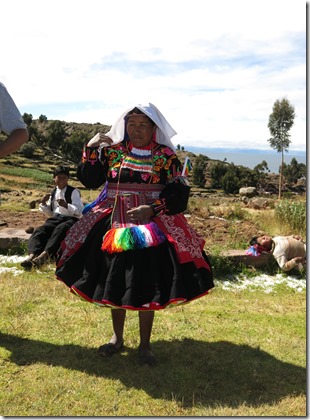
While we visited the family we were shown some of their traditional clothing:
IMG_2562

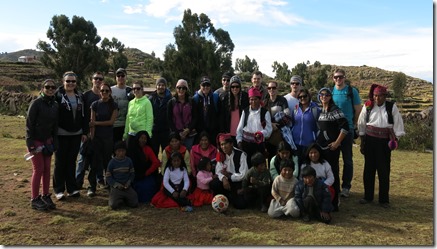
After visiting the family, we had a chance to interact with some of the children. Before visiting the island we stopped at a local shop to buy treats for the kids like fruit, crayons, colouring books, etc. The kids were very happy with their presents!

IMG_2596

IMG_2631

Before leaving the island we had more of a chance to walk around and see how beautiful the island was:
IMG_2614

IMG_2633

IMG_2638

IMG_2648

IMG_2655

I really enjoyed my visit to Lake Titikaka. I learned a lot about how the people live in two different parts of the lake, and I was able to see some beautiful views. All in all a great day!!