Friday, July 17, 2009

First Impressions of Madrid

We arrived in Madrid, Spain on the morning of July 16th after a 10 hour overnight train ride from Lisbon, Portugal. Chad had booked us an apartment right downtown Madrid for our 3 nights here, so we took a cab from the train station. Unfortunately the cab driver had no idea where this place was and we ended up waiting on the side of the street for about 15 minutes while he ran up to every passing taxi asking other taxi drivers how to get there.
When we arrived with all our luggage we found no reception, just an apartment building. So we called our reservation phone number and they told us they would meet us at the apartment no earlier than 1pm (and it was 10am when we arrived). So we spent a few hours at a local bar/café while we waited.
At 1pm we were let into the most amazing apartment. This apartment had a full kitchen (dishes, toaster, coffee maker, kettle, fridge, dish washing machine, laundry machine, oven, microwave, etc), a TV/living room with a television and DVD player, a pullout couch and dining room table, and we also had a bedroom and bathroom!! And on top of everything… FREE WIRELESS INTERNET!! Amazing!!
clip_image002
clip_image004
The first thing we did was laundry!! I have been traveling for over 3 weeks, washing my clothing in hotel/hostel sinks and bathtubs and the idea of using a real washing machine was so exciting!!
After getting settled in the apartment we went for a walk in the surrounding areas. We are situated right downtown, a few blocks south of the Gran Via Street, about a block west of the Prado Museum.
The next day we started our real touring with the Prado Museum, an art museum with the world’s greatest collection of 12th-19th century Spanish paintings as well as numerous foreign collections of artwork.
The front entrance of the Prado Museum with a statue of the famous Spanish painter Velazquez:
clip_image006
It took us most of the day to view only the permanent collections of this incredible museum. The most famous Spanish painters housed in this museum were Velazquez, El Greco and Goya. My personal favourite was Velazquez. I found that his paintings were so realistic. Goya, on the other hand, had a very diverse repertoire of painting styles. For the most part I liked his paintings, but I was not a huge fan of his “Black Paintings”, painted in the early 1800s which were a set of very dark and sinister paintings, portraying distorted humans. They were a reflection of his view of mankind and the conditions of the world.
After the Prado Museum we took a tour bus around the city to see and hear important information about the main sights in Madrid.
Madrid is such a beautiful city, but it’s different from Lisbon. I found Madrid to be a lot easier to tour as the streets are easier to maneuver and the main sights are easy to spot. One downside is that there are so many interesting and amazing things to do in Madrid that 3 days is no where near enough time to see them all!
Here are a few of the sights we saw from the tour bus:
clip_image008
clip_image010clip_image012
clip_image014
image
We then went to the Palacio Real, but unfortunately it was too late for us to enter. Instead we walked around outside.
clip_image018
clip_image020
The Catedral de la Almudena, right next to the Palacio Real:
clip_image022
After a long day of touring we called it quits and went back to our apartment.

Thursday, July 16, 2009

Last Impressions of Portugal

Unfortunately we only had 3 days in Lisbon, and they went by so fast!! Our last day in Lisbon was July 15, and we had a train ticket for Madrid leaving that evening.
Before talking about our very last day in Lisbon, I think I should tell you a bit about our experience with some authentic Portuguese chorizo sausage.
On the evening of July 14th, our 2nd last day in Lisbon, on our way back to the hostel we decided to stop and buy some food at a small shop. A Portuguese man, who only spoke a few words of English and some of French, convinced us to buy 1 kg worth of chorizo by exclaiming “C’est bon! C’est bon! It’s good! 3 Euros!”. I suppose we were pretty easily convinced, mainly because we were so hungry!
Chorizo is a sausage, made in many parts of the world, and can be either cooked or uncooked. In Portugal (and Spain) it is a fermented cured smoked sausage made from pork, fat, and lots of salt (and a few other ingredients that I’m not too sure of), and it is eaten without cooking. This makes it very heavy and hard to digest if you aren’t used to it.
Anyway, we got back to the hostel with our Portuguese chorizo and ate a few full sausages each. Needless to say, it was the worst decision we’d made all trip! I spent the rest of the night, and the following day feeling sick to my stomach and was in some pretty unpleasant pain. Chad on the other hand, with his stomach of steel, felt amazing after consuming the massive quantities of chorizo.
Since I vowed never to eat it again, we decided to give the hostel owners the rest of our chorizo. We explained to them how I got so sick from eating it, and they asked us how much we had. We causally told them we had a few sausages each and their mouths dropped in shock. After having a good laugh they explained to us that you are only supposed to have a few very thin slices of chorizo at a time since it is so heavy, and consuming a whole sausage (or multiple sausages) is not normal and definitely not recommended!!
They convinced us to keep the chorizo, and explained a technique of “cooking” it to make it less heavy. It can be cooked using a shallow pan by covering the bottom with rubbing alcohol and cotton balls. You put a grill over the pan and put the chorizo on top. Then light the cotton balls on fire, and they will burn very slowly, cooking the chorizo. Apparently this technique lets the chorizo keep the flavor, but reduces the fat content, therefore making it easier on the stomach. We have yet to try this technique.
Changing the topic back to Lisbon, we spent our last day in Lisbon at the Lisbon Oceanarium. It is the 2nd largest in the world and opened in 1998. It has 8,000 animals and plants and has a huge central tank with enough water to fill 4 Olympic sized swimming pools. Within the central tank we saw a pretty cool looking fish called the Ocean Sunfish.
clip_image002
Here are a few other photos from the oceanarium:
clip_image004
clip_image006
clip_image008
clip_image010
clip_image012
We learned that some sharks lay eggs! Here is a photo of shark eggs:
clip_image014
After the oceanarium we did a little bit of shopping and walking around the town before heading over to the train station for our overnight train to Madrid.
We both bought Euro-rail train passes to give us access to all the train routes across Europe. But even with a train pass, you still need to reserve your train tickets and pay a reservation fee. The reservation fees differ in price depending on the type of seat you want on the train. Since it was a 10 hour overnight train we thought we would go all out and reserve a private room with beds, one of the more expensive options, rather than just a seat on the train.
Our room was tiny, and there was only enough space for one of us to stand at any given time!
clip_image016
We were pretty happy with the service. The room came with free bottled water, and each one of us got a (purple) cosmetic bag with a toothbrush, toothpaste, hairbrush, razor, soap, Kleenex, sewing kit and a few other goodies. On top of the freebies in the room, a very nice breakfast (eggs, bacon, pastries, orange juice and coffee) was also included with our train room.
clip_image018
All in all a very successful trip from Lisbon into Madrid, Spain, and well worth the extra cost of the privacy, security and comfort of a private room.

Tuesday, July 14, 2009

First Impressions of Lisbon

I left Athens on July 12th and started my 17 hour journey to Lisbon, which only 5 of those hours were flying, 7 hours wait in my stopover in Vienna, 1.5 hours transit time from my hostel to the airport, and 3.5 hours of random airport waits before my first flight and after my last flight.
I arrived in Lisbon at 3am (local time, which was 2 hours behind Athens time, making it feel like 5am to me) completely exhausted. Chad was waiting for me at the airport and took me to our hotel which was just down the street from the airport. I awoke a few hours later to see a beautiful view of the city. Lisbon is such a clean, lively, beautiful city! What a drastic change from Athens!
We left our hotel with our luggages and took the metro down to the water to check into our hostel. The metro in Lisbon is excellent!! It’s clean, well decorated, and the tickets system is so advanced! You buy these small ticket cards which can be continually reloaded with money and used over and over again, so you don’t need individual tickets for each ride. Once dropping our luggages off at our new hostel we decided to explore the city by foot.
We climbed up one of the highest hills in Lisbon to find the Castelo de Sao Jorge, a castle from the 11th century. We were able to walk all around along the castle walls. It provided the most amazing view of the city!
clip_image002
clip_image004
clip_image006
clip_image008
clip_image010
clip_image012
We stopped for a drink in the castle and we were welcomed by a very large and beautiful peacock.
clip_image014
After walking around the castle for a few hours I was exhausted from my few hours of sleep so we took it easy for the rest of the day.
The next day we decided to go on a hop-on-hop-off city bus tour, so we could get an idea of all the major sites in the city and hear all about their history and importance.
The bus tour started at the Praca do Comercio, also called Palace Square, which was unfortunately under construction, but was the location of the royal palace for 400 years.
clip_image016
The tour started by driving up Rua da Prata, which was completely destroyed in the 1755 earthquake. The earthquake is known as one of the most destructive in history, reaching an estimated 9 on the Richter scale. Since almost the entire city of Lisbon was completely destroyed, they had a few options for the city: one was to demolish everything and start building the city from scratch, and another was to rebuild the city on top of the ruins. They decided to demolish the city and start building everything from the ground up. They organized the city so that the street names corresponded to activities taking place on that street.
As we were driving we saw many statues throughout the city:
clip_image018clip_image020
We then went by Lisbon’s famous bull ring, called Campo Pequeno. We learned that in Portuguese bullfighting the bull is not killed (which is not the case in Spanish bullfighting). Also, horses are very important in Portuguese bullfighting, and the horseman is usually the star of the show.
clip_image024
We then went by Lisbon’s prison, which was built right after they abolished the death penalty.
clip_image026
We then saw the Aqueduto das Aguas Livres, which is an aqueduct that supplied the city with water until 1950.
clip_image028clip_image030
From there we went over to Belem, a suburb of Lisbon, to see the Torre de Belem, a small fortress.
clip_image032
We then walked over to the Monument to the Discoveries (also in Belem), which was built in 1960 to commemorate the 500th year anniversary of the death of Henry the Navigator. The monument shows some of Portugal’s key explorers during it’s history.
clip_image034
clip_image036
We then drove by the residence of the President of Portugal.
clip_image038
clip_image040
I have to say, I was pretty excited that the building was pink!!
After our tour we were pretty tired, so we headed to the grocery store to pick up supplies, and then took a long siesta.

Sunday, July 12, 2009

Last Impressions of Athens and Greece

I spent my last full day in Athens doing a combination of touring and relaxing. I met up with my friend Jenni, who was still in Athens for a few days, and together we went to see the new Acropolis Museum. It just opened a few weeks ago and was said to be quite controversial, so we were eager to see it!
It’s a very modern looking building, and it was built on top of some ruins, so there are many glass floors and openings for visitors to see the ruins beneath.
clip_image002
clip_image004
We were also pretty excited because admission was only 1 Euro (which is a huge improvement from the 10-15 Euro admissions we were used to paying)!
Once inside, we walked through the rooms full of artifacts they found in and around the Acropolis area. Most of them were put back together and missing pieces were filled in so visitors could see what the pieces originally looked like. For example, there were many sculptures which had been broken and pieces of, let’s say an arm, were made using clay or plaster or other such material and filled into the sculpture. It was pretty interesting.
We couldn’t pinpoint exactly why the museum was said to be so controversial. We guessed that maybe it was because of the new modern building that was housing these ancient artifacts, and the building might not “fit” in. Or, more likely, because the building is situated on top of ancient ruins.
Either way, we still thoroughly enjoyed the museum.
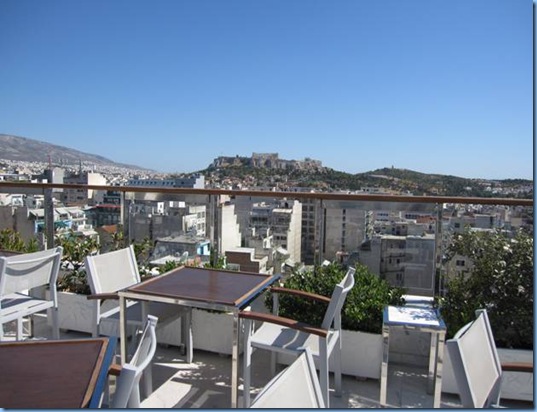
After visiting the museum we decided to spend the rest of the day relaxing at Jenni’s hotel. She is staying at this incredible hotel, downtown Athens, with a rooftop pool patio that overlooks the Acropolis and the rest of the city. We needed a break from the intense heat of the city, and this was the perfect solution!
Rooftop patio with the Acropolis in the background:
clip_image006
Jenni and I by the pool with a view of the city of Athens and surrounding mountains in the background:
clip_image008
We had a great, relaxing day, and it was the perfect end to my time in Greece before my flight to Portugal!
Before ending this blog post I wanted to share a few things I noticed or learned during my stay in Greece and Athens.
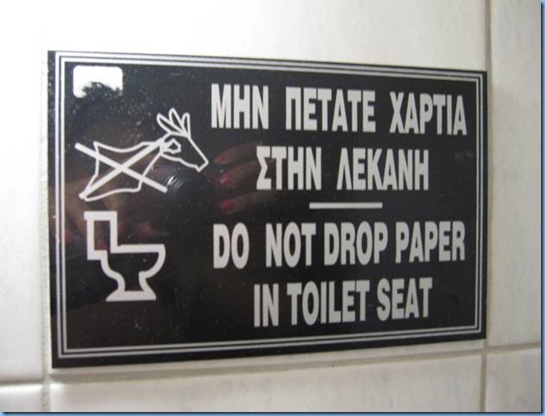
The first thing that I learned when I arrived in Greece is that you are not allowed to put toilet paper in the toilets. There is a separate bin next to each toilet for the purpose of collecting dirty and used toilet paper. This bin is usually changed daily by the management of whoever owns the toilet. On top of every toilet there were signs to remind us:
clip_image010
We were told that this was because in Greece the plumbing is very old, and it cannot handle massive loads. Needless to say, we were all a little bit worried of clogging the toilets!
Another thing I learned was Greek time. Greek time basically means the time, with an “ish” at the end. For example, if a bus/boat/train is supposed to leave at 10am, it really means it’s leaving at 10-ish, meaning it could leave at 10, 10:15 or 10:30.
Also, almost all establishments (with the exception of the tourist areas of Athens) have a little siesta in the middle of the day. Which means if you try to go shopping/eating/drinking/etc. between the hours of 2pm and 5pm you will not find anything open. During that time you should probably stay indoors, preferably somewhere with air conditioning because during those hours the temperature is usually above 35 degrees Celsius.
In general we found that Greece was cheaper than Italy. It was easy to find a bottle of water for 0.50 Euros, while in Italy it was almost impossible to find a bottle for under 1 or 2 Euros.
Another important thing to note is that in Greece, smoking is permitted everywhere! Indoors and outdoors, and cigarette ads are seen throughout the cities.
In Athens, there were also also a few things that I learned. The first thing was the overcrowding of the city. The city is so overcrowded with people and cars that they have very strict rules for driving in the city, and expensive fines for disobeying the rules. Depending on whether the date is even or odd, only license plates with either even or odd final digits are allowed to drive in the city. And it alternates daily. I would assume that wealthy people would buy two cars, one with an odd last digit and another with an even last digit so they were able to drive daily in the city.
Another pretty cool thing about the city is that there are ruins everywhere! Whenever a new building or metro station is being dug and made, they generally find ruins buried underneath. Our guide told us that there are many metro stations with little museums of ancient ruins, unfortunately I didn’t use the metro and was unable to witness this myself.
In addition, the maps are pretty difficult to read. This is because all tourists are given Athens city maps, written in English, without the use of any Greek letters. But as you walk through the streets and look at the street signs, they are all written in Greek, using Greek symbols, and they do not correspond to the words on our tourist maps. So it’s nearly impossible to walk through the streets and be sure of where you are, and the maps are pretty useless.
In general, I did not get a very good feeling from the city of Athens. I noticed it was not very well kept by the people, for example: the streets were quite dirty, and there was graffiti everywhere, even on historical buildings and monuments. I found this really sad, as Athens is a beautiful city with lots of history and architecture, but it gives off the wrong “vibe” to it’s visitors and tourists. I felt a little unsafe walking through the streets, which is probably a direct result of my getting lost incident a few days ago. I got lost finding my hotel, turned down the wrong street, and found myself walking through streets and streets full of scary, strange, dirty men all looking at me and trying to talk to me. It was awful, and it made me very uncomfortable, more uncomfortable than I have ever felt in any other European city.
All in all, I did love Greece, and I will visit it again. I most likely won’t spend much time in Athens, but instead will spend my time exploring more of the beautiful Greek islands!!

Saturday, July 11, 2009

Athens - Contiki Endings

Our time in Athens marked the end of my Contiki tour, a tour where I met a group of amazing people, had so many good times, saw some incredible sights and had new and unique experiences. To celebrate the end of the tour, we went out for our last Greek dinner as a group. The restaurant was really good, and we had all our favourites: Greek salad, tzatziki, lots of olives, fried zucchini strips, souvlaki, wine and many other goodies. We also had Ouzo, a traditional Greek liquor which has a very strong taste of black licorice, usually taken before meals to help with digestion.
During the dinner, the restaurant had Greek dancers come give us a performance:
clip_image002
During the course of the night we had a chance to say our goodbyes and take some goodbye photos.
Me with my two roommates Jess and Jackie:
clip_image004
The whole Contiki group:
clip_image006
It was sad to say goodbye to everyone as we all became a close group of friends. But the end of the Contiki tour marks the beginning of my Portugal/Spain section of my summer adventure!

Thursday, July 9, 2009

Road to Athens and the Acropolis

On July 8th we left the beautiful Greek Island of Corfu to make the trip to Athens. We took a 1.5 hour ferry to the mainland, and then a 5 hour bus ride.
From the bus we had the most amazing view of the Gulf of Corinth:
clip_image002
We made a stop at the Corinth Canal, which was built in the 1880s to connect the Gulf of Corinth with the Aegean Sea. Without the canal, boats would need to travel down to the bottom of the Peloponnesian peninsula in order to cross to the Aegean Sea.
clip_image004
Once arriving in Athens we were dropped off close to our hotel. Our hotel is a beautiful 4 star hotel, which happens to be in a very sketchy area of the city. Our tour manager and bus driver devised a system for us to remove the luggage from the coach while keeping it protected from the Greek thieves who apparently prey on tourists with large heavy luggage. We formed a large circle around the opening of the luggage area of the coach, and 5 of the “strong” guys on our tour unloaded the luggage into the protected circle.
By the time we arrived in Athens it was dinner time, so we all went out for an excellent Greek dinner. After dinner we walked back to our hotel in a large group, as we were pretty scared of the strange characters on the streets surrounding our hotel.
The next morning we went on a tour of the Acropolis. The Acropolis is on a hill, and consists of the Parthenon (the famous temple to the God Athena), The Temple of Athena Nike, and The Theatre of Herodes Atticus.
We first walked past the Theatre of Herodes Atticus, built in 161 AD and still used today for outdoor concerts.
clip_image006
We then walked up the Propylaia, the entrance to the Acropolis, which was built in 437-432 BC.
clip_image008
We finally reached the top of the hill to see the Parthenon:
clip_image010
clip_image012
Construction began on the Parthenon in 447 BC, and it took 9 years to complete. It is built using no straight lines. Each column is wider at the base and becomes narrower closer to the top. Also, the distance between columns vary, as it was believed that our eyes are so used to seeing perfection in architecture, that if it was made slightly less perfect by varying distances and widths it would give an illusion of perfection and our eyes would not become “bored” of looking at the temple.
We had a chance to walk around the Acropolis hill and see all the sights on the hill and the view of the city:
clip_image014
clip_image016
clip_image018
From the Acropolis we went to see the Olympic Stadium:
clip_image020
clip_image022
We then made our way over to the Parliament to watch the changing of the guards. It was really interesting. The changing of the guards happens once every hour on the hour, and the two guards that stand post outside the building are replaced by two new ones. The ceremony consists of three guards entering the area: one guard to accompany them and two to take over the post. The two guards who are leaving and the two new guards do an interesting series of marches and steps during the changing process. Once the two new guards have successfully taken their positions the two old guards march out with the accompanying guard.
clip_image024
The three guards marching in (the two new ones stand on either side of the accompanying guard):
clip_image026
The three guards waiting while the two old guards march out of position:
clip_image028
Finally, the two new guards marching into place:
clip_image030
I spent the rest of the afternoon walking through the streets and looking into the shops.